
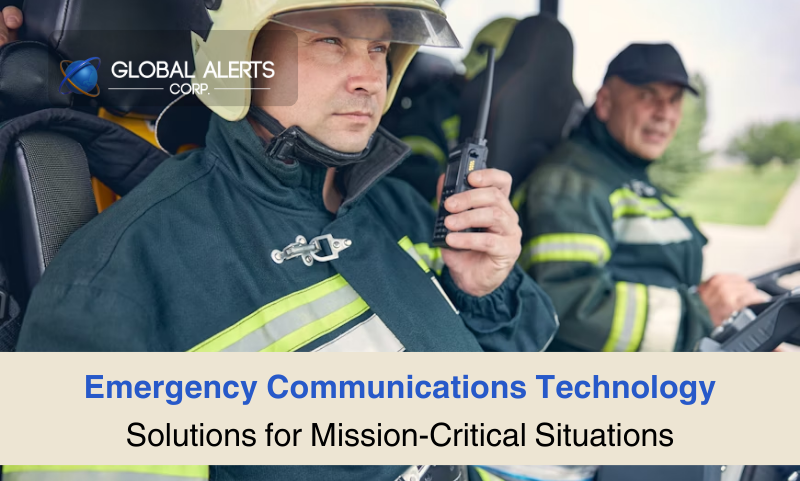
How Next‑Generation Communications Save Lives and Transform Public Safety
In today’s unpredictable world, natural and human‑made disasters are becoming more frequent and more severe. From hurricanes and earthquakes to industrial incidents, security threats, and missing‑person alerts, every second matters when lives are at stake. In these critical moments, emergency communications technology is not just a tool—it is a vital lifeline that connects authorities with the public, delivers clear instructions, and helps save lives.
Global Alerts Corp, a leader in advanced emergency notification solutions, understands this urgency. By combining cutting‑edge technology with global scalability, the company enables governments, organizations, and communities to respond quickly and effectively when crises occur. This blog explores why modern emergency communications technology is essential, how it works in mission‑critical situations, and how Global Alerts Corp is helping build safer, more resilient societies.
Why Emergency Communications Technology Matters More Than Ever
The world is more connected than ever—yet also more vulnerable. Climate change has increased the frequency and intensity of natural disasters. Urban populations are denser. Public safety challenges, security threats, and health emergencies demand fast, reliable, and precise communication.
In this environment, the effectiveness of emergency messaging can mean the difference between confusion and coordinated action. Traditional alerting methods such as sirens, manual SMS campaigns, or reliance on broadcast media alone were not designed for today’s mobile‑first societies. They often struggle with network congestion, limited reach, and poor geo‑targeting accuracy.
Modern emergencies evolve rapidly. The public expects—and depends on—timely, location‑specific information. This is where next‑generation emergency communications technology becomes essential.
Core Components of Modern Emergency Communications Technology
Modern emergency communications systems are built to be fast, reliable, and actionable. Key components include:
1. Precise Geo‑Targeted Alerting
Most emergency situations are localized. Whether responding to flash flooding, an industrial accident, or a security incident, alerts must reach only those who are actually affected.
Advanced platforms such as UPSEN use geographic areas defined by authorized agencies to target alerts with precision. Messages are delivered only to devices located within the affected zone at the time of transmission. This reduces unnecessary panic, minimizes alert fatigue, and improves public trust.
2. Resilient Network Delivery
During large‑scale emergencies, mobile networks can become congested or partially unavailable. Modern emergency communications technology relies on broadcast‑based delivery methods, such as cell broadcast, which do not depend on individual device connections or mobile data sessions.
Because messages are transmitted simultaneously to all devices in a defined area, alerts remain reliable even under heavy network load — a critical requirement in mission‑critical situations.
3. Universal Device Reach
Emergency alerts must be accessible to everyone. UPSEN enables alerts to be received on all mobile phones, including older and lower‑cost devices. Citizens do not need satellite‑compatible handsets, mobile data, applications, or paid subscriptions to receive alerts.
This universal approach ensures equitable access to life‑saving information, particularly in regions where the latest smartphones are not widely available.
4. Automation and Intelligent Processing
Time is critical during emergencies. Modern platforms integrate automation and intelligent processing to ingest data from authorized sources such as government agencies, monitoring systems, and emergency operations centers.
By reducing manual steps, these systems help issue alerts faster, with greater consistency and accuracy, while minimizing the risk of human error.
5. Multi‑Channel Communication
While broadcast alerts form the foundation of public warning, modern systems can also integrate additional channels such as SMS, email, and digital platforms. This layered approach increases reach and ensures critical information is available across multiple touchpoints.
Global Alerts Corp: Advancing Emergency Communications Technology
Global Alerts Corp stands out in the emergency communications landscape by delivering next‑generation solutions designed specifically for mission‑critical environments. With decades of experience and a strong focus on public safety, the company’s technology supports governments, regulators, and mobile network operators worldwide.
UPSEN: The Next Generation of Public Alerting
At the core of Global Alerts Corp’s portfolio is UPSEN, an advanced public warning platform built to overcome the limitations of legacy systems. UPSEN combines broadcast‑based delivery, precise geo‑targeting, and intelligent automation to enable authorities to:
- Disseminate critical alerts in real time
- Target only affected geographic regions
- Reach all mobile devices, regardless of handset type
- Maintain reliable delivery during network congestion
Where satellite technology is referenced, it serves as a resilience layer within the communications infrastructure, not as an end‑user requirement. Citizens do not need satellite devices to receive UPSEN alerts.
Global Reach and Collaboration
Global Alerts Corp works in close partnership with national authorities, telecommunications regulators, and mobile network operators around the world. Deployments across multiple regions demonstrate the company’s commitment to delivering reliable, interoperable public warning systems at scale.
Emergencies do not respect borders—and neither should the systems designed to respond to them. Global Alerts Corp helps nations strengthen preparedness and protect their populations through coordinated, technology‑driven solutions.
How Emergency Communications Technology Saves Lives
Faster Public Response
Instant, location‑specific alerts enable people to make informed decisions quickly—whether that means evacuating, sheltering in place, or avoiding hazardous areas.
Reduced Confusion and Misinformation
Authoritative alerts from trusted sources help counter misinformation, which can spread rapidly during crises. Clear messaging supports calmer, more coordinated public behavior.
Better Support for First Responders
When the public receives accurate instructions quickly, emergency responders can focus on rescue and recovery operations instead of managing widespread uncertainty.
Inclusive Access to Safety Information
Universal device compatibility ensures that life‑saving alerts reach all segments of the population, supporting equitable public safety outcomes.
The Future of Emergency Communications Technology
Emergency communications continue to evolve with advances in automation, predictive analytics, sensor integration, and intelligent decision support. These innovations will allow authorities to move from reactive alerting to more proactive risk mitigation.
Global Alerts Corp remains committed to advancing these capabilities and delivering resilient, inclusive technologies that strengthen emergency preparedness worldwide.
Conclusion
In an increasingly complex and time‑sensitive world, emergency communications technology is central to public safety. By bridging the gap between detection and action, it ensures that critical information reaches the right people at the right time.
Through platforms like UPSEN and strong global partnerships, Global Alerts Corp demonstrates how modern technology can transform emergency response—saving lives, protecting communities, and building a safer future for all. Investing in advanced emergency communications technology is no longer optional—it is essential.